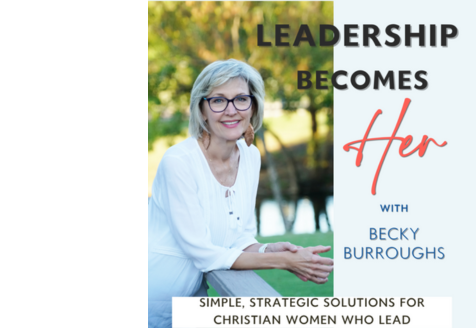
Leadership Becomes Her: Simple, Strategic Solutions for Christian Women Who Lead
The mission of Leadership Becomes Her is to help Christian women who serve in churches as a vocation or a volunteer, or women who work in non-profits or small business by equipping you to lead with faith, confidence, and purpose. You will learn to own your giftedness while identifying areas of growth in your leadership so you can navigate a path for transforming into the leaders God is calling you to be.








Episodes
26 minutes ago
26 minutes ago
32 min
Hey, Friend!
Have you ever shared an idea in a meeting and sensed that someone was more bothered by your confidence than interested in your contribution?
Have you ever hesitated to speak because you didn't want to sound like a know-it-all? Or wondered whether you needed to dial back your competence to make someone else feel more comfortable?
Sometimes being a capable woman in leadership comes with unexpected complications.
In this episode of Leadership Becomes Her, we're talking about what happens when a woman's competence, confidence, or expertise seems to create tension in the room. We'll explore the double standards women sometimes encounter, the temptation to make ourselves smaller, and how to discern the difference between legitimate feedback and expectations that ask us to diminish our gifts.
We'll also talk about the importance of remaining teachable. Not every criticism is evidence that someone feels threatened, and competence doesn't excuse poor behavior. Healthy leadership requires us to keep growing while refusing to hide the gifts and experience we've worked hard to develop.
For women in ministry, this conversation is especially important. You can respect authority without erasing your expertise. You can remain humble without hiding your gifts. And you can lead with confidence while remaining open to correction.
God has entrusted each of us with gifts to develop and use in service to others. We don't need to pretend those gifts aren't there. We need to steward them faithfully.
A question to reflect on:
Where in your leadership have you been holding back—not because you lack something to contribute, but because you're afraid of how someone might respond?
Remember: You can change your approach without diminishing your gifts. You can listen without automatically yielding. And you can be humble without being invisible.
Leadership Becomes Her offers simple, strategic solutions for Christian women who lead in ministry, business, nonprofits, and beyond.
If this episode resonates with you, share it with a woman who needs the encouragement to keep growing, keep leading, and keep bringing her gifts to the table.
I pray this blesses you,
Becky
Nov 4, 2026
Nov 4, 2026
26 min
Hey, Friend!
Have you ever made a decision you knew was right—and then spent the next three days worrying about whether people were upset with you?
Have you ever avoided a difficult conversation because you didn't want someone to think badly of you? Or said yes when you really wanted to say no?
If so, you may have fallen into the likeability trap.
In this episode of Leadership Becomes Her, we're talking about the pressure so many women in leadership feel to be agreeable, accommodating, and liked by everyone around them. While caring about people is an essential leadership quality, trouble begins when the need for approval starts driving our decisions.
We avoid difficult conversations. We say yes when we need to say no. We dilute our opinions, overexplain our decisions, and exhaust ourselves trying to manage other people's reactions
In this episode, you'll discover practical ways to escape the likeability trap, including recognizing when approval is driving your decisions, separating your responsibilities from other people's reactions, and learning to tolerate the discomfort of being misunderstood.
For women in ministry especially, this is an important reminder: You can be compassionate without avoiding conflict, humble without diminishing your voice, and faithful without being everyone's favorite person.
I pray this blesses you,
Becky
Oct 28, 2026
Oct 28, 2026
24 min
Hey, Friend!
You’re Not Too Much
Have you ever walked out of a meeting and replayed everything you said?
Was I too direct?Did I talk too much?Did I come across as controlling?Should I have softened that?Was I too much?
Too passionate. Too confident. Too opinionated. Too emotional. Too ambitious. Too strong.
So many women in leadership have learned to question themselves this way.
In this episode, we begin a new series, What Nobody Tells You About Women and Leadership, with a message every woman leader needs to hear:
You’re not too much.
Women often receive subtle messages about how much space they are allowed to occupy. And over time, we can begin shrinking ourselves—not because we lack confidence, but because we have learned that being fully ourselves might make someone else uncomfortable.
But there is a difference between growth and shrinking.
You may need to become more thoughtful, more emotionally mature, more collaborative, or more self-aware. But becoming a better leader does not require you to become a smaller woman.
In this episode, we talk about:
Why women are so often afraid of being perceived as “too much”
The difference between humility and shrinking
How confidence can be interpreted differently in women
Why having something to work on doesn't mean you are fundamentally wrong
How some of your “too much” qualities may actually be leadership strengths
What it means to become more whole rather than simply becoming less
How women in ministry can stop apologizing for their calling and leadership gifts
One of the questions I want you to take with you is:
“What part of myself have I been shrinking to make other people comfortable?”
And then ask:
“Is this something God is asking me to surrender—or something I've been taught to suppress?”
Those are very different things.
You don't have to become smaller to become better.
You are not too much.
You are becoming.
I pray this blesses you,
Becky
Oct 21, 2026
Oct 21, 2026
18 min
Hey, Friend!
In this episode, we explore six things I hope you remember:
You Don't Have to Earn Your Place at the Table.
You Are Allowed to Say No.
Your Work Is Not Your Worth.
Someone's Disappointment Is Not an Emergency.
You Need to Rest Before You're Empty.
Hard Doesn't Mean You're Failing.
Leadership isn't about becoming someone who never struggles.
It's about becoming someone who knows where to take the struggle.
You don't have to lose yourself to lead well.
You don't have to become less human to become a better leader.
You simply have to become more fully who God created you to be.
That's the leader I hope you're becoming.
And that's what I hope you take with you.
Leadership isn't just about what you accomplish. It's about who you're becoming.
With Love,
Becky
Oct 14, 2026
Oct 14, 2026
18 min
What if your greatest strength has a shadow?
Hey, Friend!
I have a question. What are you really good at?
Maybe you're dependable.
You get things done.
Maybe you're compassionate.
You notice people and care deeply about them.
Maybe you're decisive.
When everyone else is still talking, you're ready to move.
Maybe you're relational.
You know how to connect people and make them feel seen.
Maybe you're confident, organized, visionary, or a natural problem-solver.
Those are strengths.
But here's the question I want you to consider:
What happens when your strength becomes too much of a good thing?
Because every strength has a shadow.
The decisive leader can become controlling.
The compassionate leader can become a rescuer.
The dependable leader can become an overfunctioner.
The relational leader can become conflict-avoidant.
The confident leader can become unteachable.
The visionary leader can become impatient.
And the servant leader can slowly disappear herself in the process of serving everyone else.
The strength isn't the problem.
The lack of self-awareness is.
In this week's episode of Leadership Becomes Her, we're talking about Every Strength Has a Shadow.
We'll explore how to recognize when your greatest leadership strength is getting out of balance—and what you can do about it.
Because leadership maturity isn't about becoming less of who you are.
It's about becoming flexible enough to choose what the situation requires instead of automatically relying on your default strength.
So here's your question for the week:
What is your greatest leadership strength—and when does it become too much?
You may discover that the very thing that has helped you succeed is also something you need to learn to hold more lightly.
🎧 Listen to Every Strength Has a Shadow wherever you get your podcasts.
I pray this blesses you,
Becky
Oct 7, 2026
Oct 7, 2026
20 min
Hey, Friend!
What are you tolerating right now that is costing you?
Maybe it's a person who consistently oversteps.
A team member who isn't carrying their share.
A situation you've been hoping will change.
A conversation you've been avoiding.
A calendar that has no room left in it.
A responsibility you've taken on because “it's just easier if I do it myself.”
Or maybe it's a pattern in yourself that you've been putting up with for far too long.
We all tolerate things.
Sometimes that's wisdom. Not everything needs to be confronted or changed.
But sometimes we're tolerating something because addressing it feels harder than living with it.
And there's a cost.
In this week's episode we're taking a closer look at the hidden price of what we allow to continue.
Because the cost isn't always obvious.
It might be costing you:
Time
Energy
Peace
Trust
Joy
Credibility
Your best people
Your ability to lead well
I call it the tolerance tax.
And here's the question I want you to consider:
Don't just ask what it will cost you to change. Ask what it will cost you if you don't.
I pray this blesses you,
Becky
Sep 30, 2026
Sep 30, 2026
24 min
Hey, Friend!
In this week’s episode, we’re talking about Stop Asking “What Should I Do?” Ask This Instead.
We’ll explore what happens when we:
Take responsibility for things that belong to other people
Confuse caring with fixing
Try to make everyone happy with our decisions
Carry outcomes we can't control
Ask other people to make decisions that are really ours to make
And struggle to trust God with the things that aren't ours to carry
Here's a question to take with you this week:
What is mine to do—and what is mine to release?
Because you don't have to fix everything you notice.
You don't have to carry everyone you love.
You don't have to make everyone happy.
And you don't have to solve the whole problem today.
Sometimes you simply need to discern the next faithful step.
What is mine to do?
I pray this blesses you,
Becky
Sep 23, 2026
Sep 23, 2026
21 min
Hey, Friend,
What if changing your mind isn't a sign of weak leadership?
What if it's a sign that you're growing?
As leaders, we often celebrate decisiveness, confidence, conviction, and consistency. And those are good qualities.
But sometimes we take them too far.
We become afraid to reconsider a decision because we don't want people to think we were wrong.
We defend a position simply because we've already taken it.
We confuse consistency with integrity.
And we forget that sometimes the wisest thing a leader can say is:
“I've changed my mind.”
In this week's episode of Leadership Becomes Her, we're talking about The Courage to Change Your Mind.
We'll explore:
Why changing our minds can feel like admitting weakness
The difference between wisdom and indecisiveness
Why secure leaders can admit when they're wrong
How refusing to reconsider can damage trust
What new information, experience, and perspective can teach us
And what our faith has to say about humility, listening, and being willing to grow
Here's a question I want you to consider:
Am I more committed to being right—or to doing what is right?
Because you don't have to defend yesterday's decision simply because you made it yesterday.
You are allowed to learn.
You are allowed to grow.
You are allowed to see something differently.
And you are allowed to change course.
That's not weak leadership.
That's courageous leadership.
I pray this blesses you,
Becky
Sep 16, 2026
Sep 16, 2026
11 min
What if “I don’t know” is good leadership?
There are three words that can be surprisingly difficult for a leader to say:
I don’t know.
We often assume that good leaders have answers. We’re supposed to know what to do, what comes next, why something happened, and how to fix it.
And for women in leadership, there can be an added pressure to prove that we belong by being competent, prepared, and capable.
But what if saying “I don’t know” isn’t a sign of weak leadership?
What if it can actually be a sign of confidence?
In this week’s episode of Leadership Becomes Her, I’m talking about The Art of Saying “I Don’t Know.”
We’ll explore:
Why leaders can feel pressured to always have the answer
The difference between confidence and certainty
How admitting what you don’t know can actually build trust
When “I don’t know” is humility—and when it becomes an excuse
How to invite others into leadership instead of pretending to have all the answers
And what our willingness to not know has to do with faith
Because the truth is, you don’t have to know everything to lead well.
You can say, “I don’t know yet.”
You can say, “Let’s figure it out together.”
And sometimes, you can simply say, “I don’t know what God is doing—but I trust Him.”
That isn't weakness.
It may be one of the most honest—and courageous—things a leader can say.
Listen to this week’s episode of Leadership Becomes Her: The Art of Saying “I Don’t Know.”
And then ask yourself:
Where am I pretending to know because I’m afraid of what people will think if I don’t?
Becky
Sep 9, 2026
Sep 9, 2026
17 min
Hey, Friend!
Throughout The Lie series, we've exposed six lies that Christian leaders can quietly believe:
I have to say yes to everyone.
My worth comes from my work.
Everyone has to like me.
I can rest when everything is finished.
More ministry means more faithfulness.
If I were better, this wouldn't be so hard.
And underneath all of them is a similar message:
Try harder. Do more. Be better. Prove yourself.
But the gospel offers us something very different.
You don't have to prove your worth.
You don't have to earn God's love.
You don't have to meet every need.
You don't have to be liked by everyone.
You don't have to do everything.
And you don't have to become a better version of yourself before God can work through you.
Jesus invites weary and burdened people to come to Him and receive rest.
Lie: If I were better, this wouldn't be so hard.
Truth: Hard doesn't mean I'm failing.
Maybe you're not failing.
Maybe you're growing.
Maybe you're grieving.
Maybe you're learning.
Maybe you're carrying something heavy.
Maybe you're simply in a hard season.
And maybe God isn't asking you to become someone else before you can be faithful.
Maybe He's inviting you to bring your whole, imperfect, sometimes-tired, sometimes-confused self to Him.
You can be human and faithful at the same time.
And remember:
Leadership isn't just about what you accomplish. It's about who you're becoming.
I pray this blesses you,
Becky
Leadership Becomes Her
Simple, Strategic Solutions for Christian Women Who Lead
Do you find yourself in a leadership role at your church or non-profit with the education you need but without leadership training?
Do you ever feel like you don’t have a voice or that your voice is not being heard?
Have you been told that you are too much or not enough?
Do you worry about what others think of you?
Are your secret fears affecting your leadership?
Do you run from conflict at all costs, convincing yourself that you are fine when, clearly, you are not?
Do you put yourself last, postponing any type of self-care because you are trying to take care of and please everyone else?
Have you started to question your calling?
The mission of Leadership Becomes Her is to help Christian women who serve in churches as a vocation or a volunteer, or women who work in non-profits or small business by equipping you to lead with faith, confidence, and purpose. You will learn to own your giftedness while identifying areas of growth in your leadership so you can navigate a path for transforming into the leaders God is calling you to be.
All too often, women who volunteer in churches or non-profits, as well as stay-at-home-moms do not see yourselves as leaders. However, volunteers are often given huge responsibilities by organizations that cannot afford to hire more employees and stay-at-home-moms usually manage the entire household. It is important to note that leadership is not about power, it is about responsibility and women throughout the ages have demonstrated just how responsible they are.
I emphasize foundational leadership skills like: establishing credibility, finding your courage and overcoming fear, building confidence, learning to communicate effectively, and developing strategies for managing conflict in a way that strengthens relationships.
You will learn how to master your mindset and overcome fear
You will develop the toolbox to lead and manage your life, and resolve conflict in a way that builds healthy relationships
Ways to Connect:
Learn: https://beckyburroughs.com/
Connect: hello@beckyburroughs.com
Facebook: https://www.facebook.com/beckyburroughscoaching
Instagram: https://www.instagram.com/becky_burroughs_coaching/
Linkedin: https://www.linkedin.com/in/becky-burroughs-898a6118a/